
Rising Higher, Turning Towards Wisdom, Moving Towards Green - A Record of the Renewal of Shanghai's Chemical Industry
Pollution, energy consumption, backwardness - once, in the minds of many people, the "associative words" associated with the chemical industry were not pleasant. However, in Shanghai, this traditional industry is undergoing a "transformation and rejuvenation" towards high-end, intelligence and greenness - the "value" of the products has increased, the unit energy consumption has decreased, and the production process has become more efficient.
Since the "14th Five-Year Plan" period, the annual compound growth rate of Shanghai's chemical new materials industry has consistently exceeded the average growth rate of the city's industrial sector. A transformative change is unfolding vividly along the banks of the Huangpu River.
Rising to the "higher" level, traditional industries bravely explore new high-end market segments
As we followed the carbon fiber production line of Shanghai Petrochemical Company, we saw millions of thin white raw fibers like spider silk. After undergoing processes such as oxidation and carbonization, their colors gradually changed from pure white to golden yellow, then to brownish yellow, and finally turned into dark black carbon fiber strands, becoming a high-end material known as "black gold".
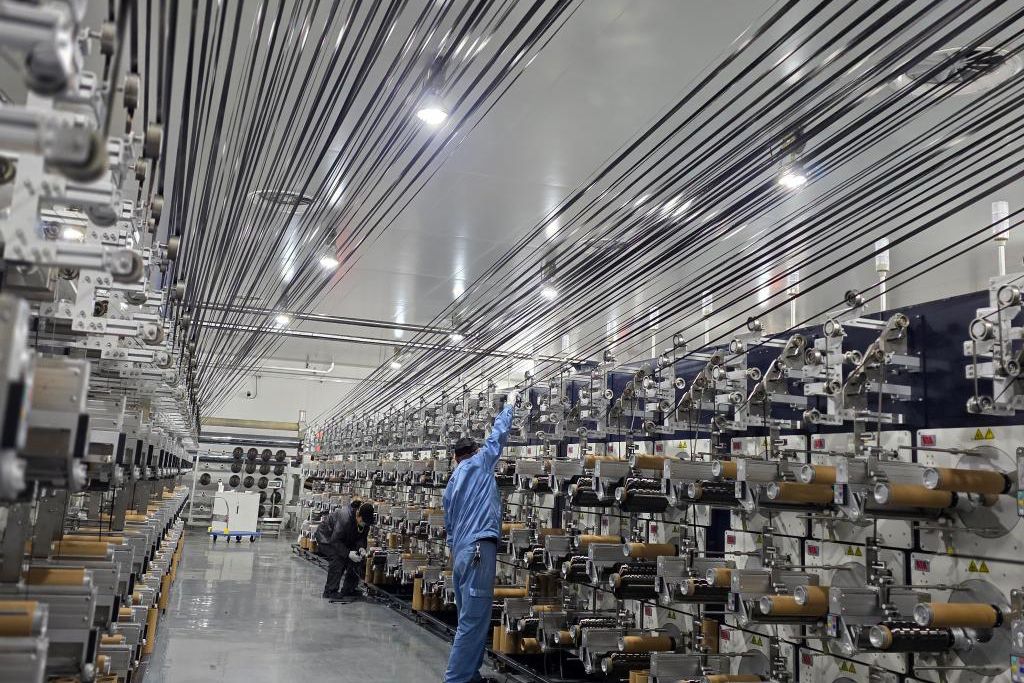
In the carbon fiber production line of Shanghai Petrochemical, after undergoing processes such as oxidation and carbonization, the white raw fibers have transformed into long strands of dark black carbon fiber filaments. Photo by Wang Muling, Xinhua News Agency.
After years of research and trial production, our company became the first in China to master the industrialization technology of 48K large filament carbon fiber, and in 2022, we completed the construction and commissioning of the first domestic production line for 48K large filament carbon fiber. Gu Yujiagai, the deputy manager of the Carbon Fiber Department of Shanghai Petrochemical, said.
Shanghai Petrochemical started in the 1970s with the aim of "solving the problem of clothing shortage for the entire nation". Its acrylic fiber industry once accounted for half of the national market. The current "Carbon Fiber Division" was formerly the "Acrylic Fiber Department" that produced raw materials for clothing and home textiles.
Gui Youjia told reporters that currently, Shanghai Petrochemical's carbon fibers have been applied in large-scale wind turbine blades, new energy storage and other fields. They are also actively inquiring about enterprises related to the low-altitude economy. "Our sales volume in 2025 has doubled compared to the previous year. The order volume in January 2026 has reached the highest monthly record since the production line was put into operation."
The magnificent transformation of the old workshop of Shanghai Petrochemical Company is precisely the epitome of the advancement of Shanghai's chemical industry towards higher levels. More stories of aiming for new goals and daring to innovate and break through continue to unfold in Shanghai -
Shanghai Huayi New Materials Co., Ltd. aimed to reduce its heavy reliance on imported catalysts. Over the past 10 years, it has continuously conducted research and development and improvements, successfully developing a new type of acrylic acid catalyst. By integrating production process innovations, the manufacturing costs of acrylic acid and ester products have been reduced by over 30%. The chemical new materials enterprise Arios independently developed the polymer virus-removing filtration membrane technology, which has broken through the technical barriers long held by European and American enterprises. The membrane products derived from this technology are expected to become a key component for ensuring the safety of domestic biopharmaceuticals...
As the core area for the chemical industry in Shanghai, the Shanghai Chemical Industrial Zone focuses on three major directions: semiconductor photoresist, electronic special gases, and wet electronic chemicals. With a total investment of approximately 13 billion yuan, it has completed the construction of a 40,000-square-meter strategic storage facility for electronic chemicals.
Shift towards "intelligence", moving from experience-driven to data-intelligence-driven.
Entering the equipment area, he took out the handheld intelligent inspection terminal. The device supervisor of the Ketone and Benzene Unit of the Refining Department One, Pan Yao, gently placed the inspection wireless probe on the machine pump to be inspected. The data such as the rotational speed and temperature of the equipment quickly appeared on the terminal screen and were simultaneously uploaded to the enterprise's big data backend.
Pan Yao's workplace, Gaoqiao Petrochemical, is a petrochemical enterprise that requires continuous 24-hour production. Patrol inspection is one of the important positions for ensuring safe production.
The veteran workers at the factory once mentioned that earlier, they could only rely on a sound detector to listen to the internal rotation sounds of the equipment and determine the operating condition based on whether there were any noises. This "sound detection and problem identification" ability could only be accumulated through years of practice and no other methods were available. "Nowadays, with the digitalization of petrochemical production, the experience of the veteran workers has been transformed into quantifiable and monitorable data, enabling 24-hour uninterrupted monitoring of the equipment." Pan Yao said.
This is not an isolated case. Many of the interviewed enterprises unanimously mentioned the same trend - the deep integration of digital technologies such as artificial intelligence, digital twins, and industrial internet with chemical process flows, which is driving the chemical production to shift from "experience-driven" to "data and intelligence-driven".
"It's like an experienced traditional Chinese doctor taking a pulse and prescribing a treatment. After the digital transformation, one can immediately access multiple experienced traditional Chinese doctors for collaborative consultations through intelligent tools." said Yang Lidu, the deputy general manager of Shanghai Huayi New Materials Co., Ltd. In chemical production, problems that previously required relying on smell, sight, and experience to judge have now been addressed earlier through various digital and intelligent means. As a result, the safety and stability of chemical production have been significantly improved.
Digitalization brings more tangible benefits to enterprises.
Huang Yu, Vice President of Covestro and General Manager of Covestro's Shanghai Integrated Base, said that Covestro has a batch-produced HDI tri-component product that has a good market demand. Previously, due to limited production capacity, they were unable to meet the demands of more customers. "In recent years, we have used large-scale AI models to optimize the production process, reducing the production time for each batch by 5%. The extra time has increased the production capacity per unit time, bringing tangible benefits to the company."
Head towards "green", which means both "producing green" and "green production"
By the end of 2025, the 100,000-ton green methanol project in Shanghai Chemical Industrial Zone will be put into operation. It is expected that soon, the shipping vessels at Shanghai Port will be able to "drink" the first batch of locally produced green methanol fuel. Looking back at the upstream raw material sources of green methanol, it is surprising to find that the local pigs and cows raised in Shanghai also contribute to it.
In Langxia Town, Jinshan District, there is a large-scale ecological pig farm with a capacity of housing over 45,000 pigs. This farm is located in the "Songlin Building" area. Just across the wall is the "Jinshan Guangming Dairy Cow Farm". Every day, both the pigs and the cows produce a large amount of manure.
The environmental team of Shenergy Group has pioneered a new path of "transforming waste into green": The fecal waste undergoes anaerobic fermentation to produce biogas, which is then purified and refined to become biogas meeting pipeline standards and integrated into the gas pipeline network. Eventually, it is transported to the Shanghai Chemical Zone and becomes the raw material for the green methanol project.
"What used to be an environmental challenge has now become a treasure with both 'value' and 'green value'." said Lu Qiang, the deputy general manager of Shenji Energy under Sheneng Environment.
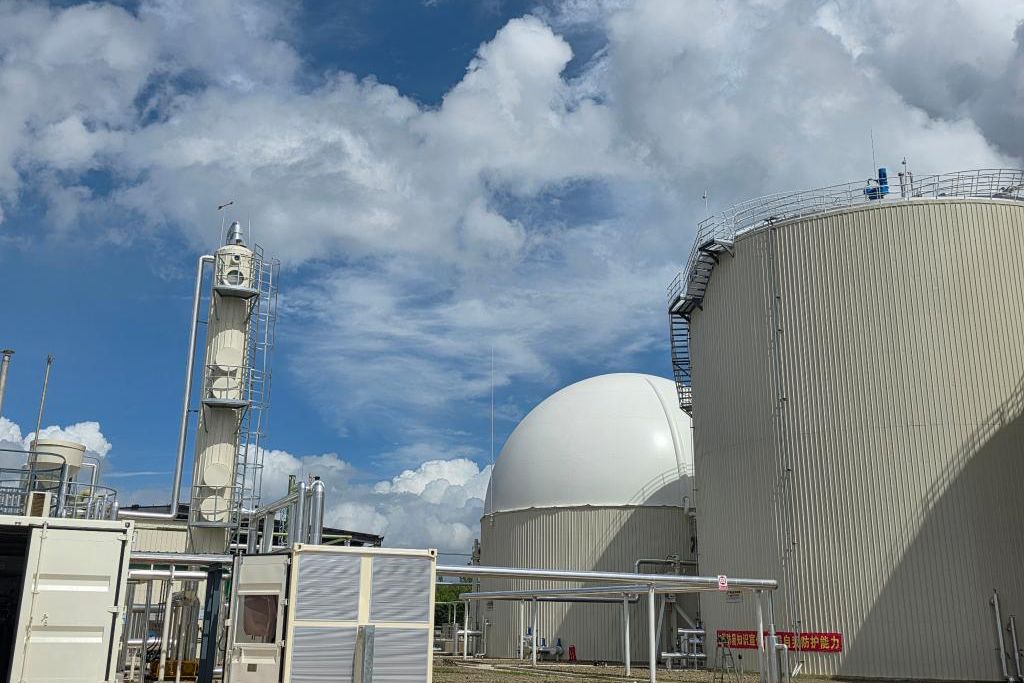
Scene of the biomass waste resource utilization project at Guangming Dairy Farm of Jinshan Modern Agricultural Park. Photographed by Wang Muling of Xinhua News Agency.
The green transformation of the chemical industry requires not only the production of green products but also the implementation of green production methods.
"The integrated production base of Covestro in Shanghai is our company's largest, most efficient and technologically advanced production site globally," Huang Yu explained. There are two sets of data that are particularly revealing - in 2025, the energy consumption of this base was less than 10% of the total energy consumption of the Shanghai Chemical Zone, yet it contributed 16% of the zone's output value; compared to when industrial-scale large-scale production began in 2009, the carbon dioxide emissions per unit product of this base in 2025 were reduced by 70%.
In Cosen's green production process, there are also many ingenious ideas of "making full use of every resource". The steam needed for production comes partly from the company's internal optimization efforts, where the waste heat from the production process is reused; the other part comes from "neighbors" within the chemical zone, through the pipeline network within the park, enabling the idle steam to utilize its residual heat, transforming the green production from a single enterprise's independent effort into a collaborative effort of the industrial ecosystem in the park.
Traditional industries are not mere observers of new quality productive forces, but rather important practitioners. The Party Secretary and Director of the Shanghai Chemical Industry Management Committee, Ruan Li, stated that efforts should be made to accelerate the cultivation of new quality productive forces in the chemical industry, to support the stability of the leading industry's supply chain, and to make these new quality productive forces become the "new engine" for Shanghai to build a modern industrial system.